|
||||||||||||||
|
||||||||||||||
|
Winds of Change Newsletter, March 2010 See sidebar for table of contents
Going Solar in Roane County - Off-Grid is Good by Mary Wildfire The last issue of Winds of Change included a story about solar powered homes in Lincoln County; this time Im focusing on two in Roane County, mainly the one I share with Don Alexander, OVECs webmaster. Our system began operating, fittingly, on Thanksgiving Day. It has four 220-watt panels for a total of 880 watts. Because we have had it only throughout the shortest, darkest days of the year, its hard to say how it will perform in year-round operation. So far, the most weve taken in is 5 kilowatt hours on a perfectly clear day. But even on the darkest days, we get some power, and snow cover amplifies weak light wonderfully: Ive seen 140 watts coming in while it was snowing.
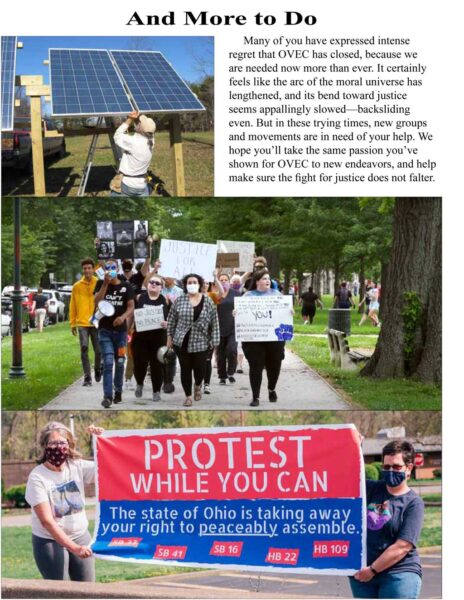
The panels are not on our roof, but rather in our yard, because we built the house up against the woods on the west side for afternoon shade. Solar panels are more efficient at lower temperatures, which is another advantage to placing them in the yard rather than on a roof where heat from the house will lower efficiency. Don decided not to spend nearly a thousand dollars on a mounting rack. He set three pressure-treated six-by-sixes into concrete, and onto these, he mounted two big racks made from lumber. Each holds two panels and can be adjusted to change the tilt seasonally (see photo). Our system is off-grid, but we still have a line connected to the neighbors house; so far, we have drawn a total of about 10 kilowatt-hours of dirty, dirty coal-fueled power over about 10 weeks. The key to living well with off-grid power is to find ways to lower your energy use. We have a conventional refrigerator, but its a modern one, much more efficient than older ones, and Don has plans to insulate it further. It uses about a kilowatt-hour a day, more in summer and less in winter. He has already modified some LED lights, so that we are able to read through these winter evenings, using a piddling 2 watts of energy each! We also have some compact fluorescent lights for cooking and other uses. We use laptop computers that use less energy than desktops, but here, too, he has plans to cut their appetites. The microwave, blender, well-pump and the recharger for the electric drill all use high power, but only for brief periods. Don modified his electric piano so it uses hardly any power; hes still trying to figure out how to do that with the cordless phone and answering machine. The total cost was $9,076. We will be able to take 30 percent of this off federal income tax, as well as the maximum $2,000 off state taxes. Its likely that we wont owe that much this year, but in both cases its possible to roll the remaining credit over to future years. So, our total cost for the off-grid system should be in the neighborhood of $4,350 after tax credits. The panels should be good for 30 years, albeit with very slowly decreasing efficiency. I know people who are still using panels that are 30 or more years old. Most of the other components should also last many years. The exception is the batteries, expected to last five to seven years. Does it make sense economically to go this route if you have access to grid power? Not in West Virginia, where 98 percent of the grid power comes from coal, which is "cheap." However, I estimate that 95 percent of the real costs of coal are externalized, meaning theyre not covered in our power bills. Readers of WOC will not need these costs spelled out. I must acknowledge, though, that spending the money to set up a solar energy system doesnt exempt me from paying the 95 percent of the costs of coal not billed directly. Don and my son have asthma, for example. But it feels better to stop contributing to the problems, and the independence is a plus when the grid goes down, as it did for the week before Christmas. Rick and Ann Kent also live in Roane County and have two separate off-grid solar systems. One was purchased by a previous owner in the 1980s; it powers most of the appliances in their cabin, although it only totals perhaps 100 watts. A newer one with 500 watts currently runs only a freezer, a 5.8 cubic foot SunDanzer. The Kents are the only people Ive talked to so far using the bigger L-16 batteries rather than the "golf cart" T-105s. They also have a super-efficient CFL light, using 5 watts to light the whole room. They run a laptop computer and sometimes watch DVDs on a small television. Being off-grid was not really a choice for the Kents the power company wanted $26,000 to run lines to them. The things to avoid if youre contemplating getting your electric appetite down to a level that makes solar affordable are electric heating, air conditioning, water heating, freezers and big outdoor lights. Also, avoid modern gas stoves with ovens that require electronic ignition for the oven, using 400 watts the whole time its on! A good first step is to get a Kill-a-Watt to measure exactly how much power youre using for each appliance. After finding ways to get your consumption down to a much lower level, youll be ready to decide whether a grid-tied or off-grid system works best for your situation, and find advice on choosing components. Im starting Coal Free WV, a network of people already living with renewable power to advise others in their neighborhoods. If you have a windmill, solar panels or a microhydro system and youre willing to talk to people interested in setting up their own, please contact me at wildfire@spectrumz.com. |
|||||||||||||
|
||||||||||||||