|
Clean Water Act
The 1972 Clean
Water Act [33 U.S. Code sec. 1251 et. seq.] gives EPA
the authority to set effluent standards on an industry-by-industry
basis.
Clean Water Act discharge permits.
The Act prohibits discharge of pollutants into U.S.
waters unless a National Pollution Discharge Elimination
System (NPDES) permit has been obtained.
The discharge permit relates
to "discharges into the navigable waters."
33 U.S. Code sec. 1342. Navigable waters include "all
waters of the United States." 40 CFR sec. 122.2.
That term has been given the broadest possible interpretation
to include most intrastate waters. Most states have been
given authority to issue the NPDES permits. The primary
purpose of each permit is to establish enforceable effluent
limitations, which are technology-based and are rather
complicated. Compliance depends largely upon self-monitoring.
Water quality standards
and policy. Water quality standards
are established by the states and consist of use classifications
and criteria that, if not exceeded, will protect those uses.
For example, water uses are pubic drinking water, propagation
of fish and wildlife, recreation, industrial, and swimmable
waters. In October 2000 the federal EPA proposed
modifying the 1980 Ambient Water Quality Criteria National
Guidelines. Those guidelines aim to get states to adopt
numeric values limiting chemicals harmful to us humans.
Each state adopts an anti-degradation
policy [see below] designed to maintain both current
uses and uses designated in the state water quality standards.
40 CFR sec. 131.12.
Water quality standards and
anti-degradation policy are complementary regulatory devices.
The first limits the concentration of pollutants and below
those limits streams are not safe for specified uses. The
second says that current water quality may not be lowered
(degraded), even if additional pollution would not violate
water quality standards.
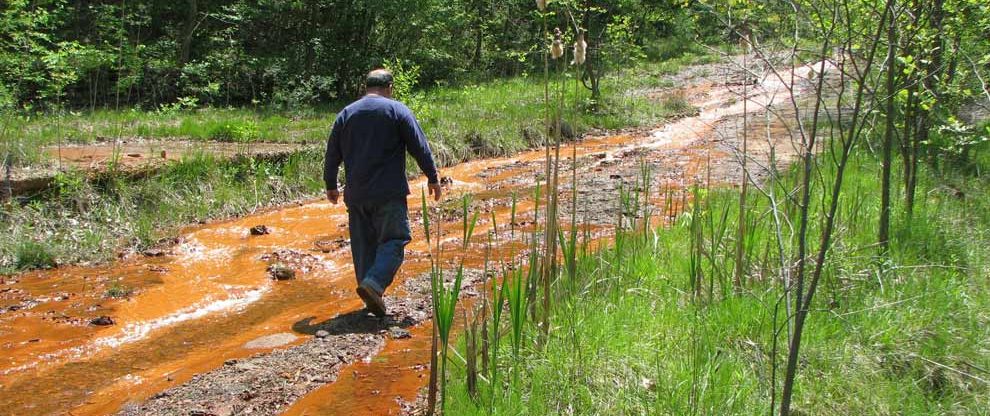
Impaired streams. For some
streams effluent limitations are not stringent enough to
implement water quality standards. The CleanWater
Act requires states to identify such waters, often portions
of well-known streams. Commonly this mandate spotlights
streams where there are multiple dischargers.
Two federal strategies
have emerged to deal with heavily polluted streams.
The first approach, TMDL, involves
calculating the total load of pollutants that a segment
of a stream can receive without exceeding water quality
criteria. The second tactic, from the Water
Quality Act of 1987, requires states to make lists of
"impaired" streams and to identify
point sources of toxic pollutants and to develop "individual
control strategies" (ICSs).
TMDL. The first strategy,
TMDL (Total Maximum Daily Load), is a winner.
Environmental advocates ask U.S. district courts to require
the federal EPA to intervene when state governments have
not acted. This is exactly what has happened in West Virginia
in a lawsuit in which OVEC participated.
The successful result was
a consent decree, signed by the district court judge,
memorializing a settlement agreement with the federal EPA.
The TMDL approach is holistic in that it covers all
pollution sources in any watershed -- point, nonpoint, natural
background sources, and regardless of whether a point source
of pollution is using the best available technology.
The federal EPA is required by
the consent decree in the West Virginia lawsuit to
draft TMDLs for 46 rivers and lakes and for over 500 acid
mine drainage (AMD) impacted stream segments. EPA is to
draft TMDLs for the 46 "section 303(d)" streams
at a rate of about seven per year from 1997 through 2002
and all TMDLs are subject to public comment.
The first seven streams were:
Blackwater River, Potomac River (South Branch; South Branch,
North Fork; South Branch, South Fork), Lunice Creek, Mill
Creek, and Anderson Run. The 500 AMD streams will have TMDLs
by 2006. The TMDL process is explained at two web
sites: http://www.epa.gov/...
and http://www.dep.state.wv.us/...
The 303(d) list of streams and methodology: http://www.dep.state.wv.us/...
Anti-TMDL sentiments
have been expressed by some businesses. They stress infringement
of property rights and invite fear among farmers and landowners
concerning imposed costs for clean-up of streams affected
by runoff from farms.
Nationally, the invigorated
TMDL process caught many states off guard. TMDL largely
was overlooked in the 1980s and 1990s as states focused
on bringing point sources into compliance. Suggestions for
reforming the TMDL process were made in a June 2001 report
in the National Research Council TMDL Study. The report
bolstered resistance by opponents of TMDL.
Anti-TMDL lawsuits ensued.
In July 2001 the Bush II administration urged a delay in
consideration of a federal appeals court lawsuit challenging
a TMDL program. It was thought that the delay was sought
to pursue weakening of the TMDL process.
Clean-up plans. Around
the country EPA has heightened pressure on states to produce
acceptable clean-up plans so that states
can enforce Clean Water Act provisions. There are, of
course, practical difficulties in enforcing limits for runoffs
in rural farming areas. Nonetheless, the watershed-by-watershed
approach to stream clean-up has gained political favor
at the federal EPA. The EPA has made separate agreements
with the state of West Virginia to improve its rivers and
streams as part of its ongoing watershed assessment program.
If the state fails to meet certain interim deadlines, EPA
has agreed to step in and accomplish the task.
Impaired streams.
In September 1998 West Virginia's DEP produced its biennial
list of impaired streams, that is, those not meeting
federal and state water quality limits. On the list
were 488 streams tainted by acid mine drainage, 60 streams
polluted by acid rain, and 99 streams impaired by pollutants
of unknown sources. The list is updated annually and you
can access the current 303(d) list of impaired streams
at http://www.dep.state.wv.us/...
The impaired streams list for Kentucky can be accessed at
http://water.nr.state.ky.us/...
A 303(d) stream can be delisted.
The Upper Blackwater River through Canaan Valley was delisted
in a lawsuit in Kanawha County in May 2001.
Standards. In West
Virginia water quality standards are set by
the Environmental Quality Board [WV Code
sec.22B-3-4]. The standards are rules and appear at
46 CSR 1. Per a federal district court ruling the federal
EPA reviews and approves state water quality standards.
In June 1999 EPA disapproved West Virginia's standards for
background pollution levels, measurements of minute amounts
of chemicals, fish toxic limits, and standards for iron
and chromium.
West Virginia's 1981 anti-degradation
policy, as modified in 1995, is a rule and appears
at 46 CSR 1-4. "It is the policy of the State
of West Virginia [that] the waters of the state shall
be maintained and protected...." "High quality
waters" are to be maintained unless the Board concludes,
after public comment and hearing, that "allowing lower
water quality is necessary to accomodate important economic
or social development...." Unfortunately, West
Virginia lacks a plan to implement the policy acceptable
to the EPA.
In June 1999 EPA told the
Environmental Quality Board (EQB) to adopt adequate methods
to support its anti-degradation policy or else EPA would
select those methods. A month before, the West Virginia
Rivers Coalition had filed a notice of intent to sue EPA
for not compelling the state board to write an implementation
policy.
From then on there was a
running battle between the Clinton-era EPA and this state's
EQB. However, once the Bush II administration took office,
EPA backed down from its strong stance on anti-degradation.
The 2001 edition of the West Virginia Legislature passed
an egregious anti-degradation bill. It has more loopholes
than a piece of federal tax legislation. The EQB moved on
its proposed anti-degradation rule in May through July 2001.
This swiss cheese legislative
regulatory approach removed all non-point sources from anti-degradation
review -- including logging, oil and gas, coal (valley fills),
highways. Existing NPDES permit holders are exempt unless
there is significant increase of discharges. The trigger
for review no longer is baseline quality but assimilative
capacity, thus allowing higher levels of pollution before
review kicks in.
One of the central issues
in water quality policymaking is the degree of protection
streams receive. The federal approach is to divide steams
into two tiers of protection. Tier 2 streams meet water
quality standards and are supposed to be maintained as such.
The quality of Tier 1 streams may be lowered until water
quality standards are met. Many in the West Virginia business
community want to designate most of the state's streams
as Tier 1 streams.
3 Techniques. So far this discussion
has focused on chemical-specific limitations.
Because of the difficulty in setting individual water-quality
based permit limitations, states are relying more on whole
effluent toxicity (WET). This involves laboratory testing
of of effluent on selected species of aquatic life.
A third technique for limiting water polution is using biological
assessments. That is, comparing in-stream characteristics,
such as species diversity and number, with the same characteristics
of clean water. All three techniques are necessary
for limiting water pollution.
Last updated on Wednesday, July 25, 2001
|