|
Adverse Effects of
Coal Mines
Out of sight,
out of mind. Most visitors to West Virginia will not
see the adverse effects of coal mining. They are hidden
by the isolation of coal mines in sparsely populated areas
of the state. People who hike, fish, hunt, camp, and otherwise
venture beyond main thoroughfares may encounter troubled
waters.
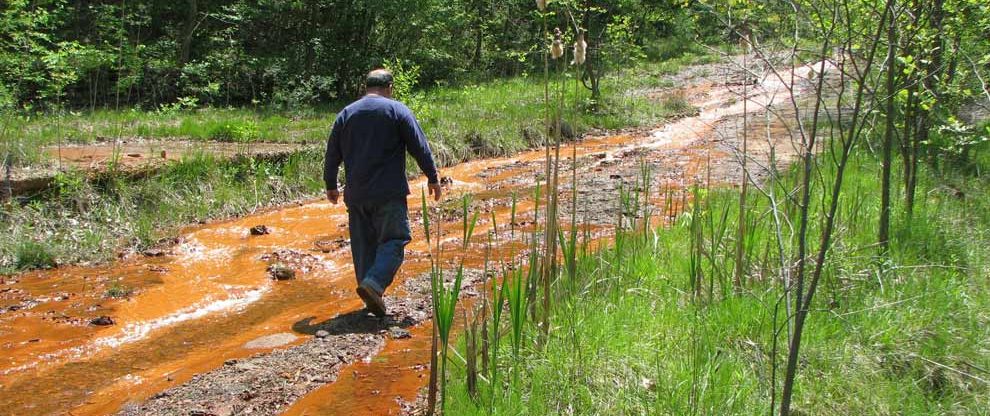
AMD. Visitors and
locals, who have had the pleasure of navigating the Cheat
River or playing in the Buckhannon River or in a host of
other streams or rivers, have been
mortified by the ugly, orange-yellow residue on river banks
and rocks left by acid mine drainage. The scene looks
as if a misguided artist has turned natural beauty into
a cosmic joke. Progress has been made in treating affected
streams but there is a long way to go to correct the situation.
Acid mine drainage (AMD)
affects the North Branch of the Potomac River, known for
its white water rafting. The Interstate Commission on the
Potomac River (ICPRB) is concerned that AMD hinders deters
inflow of people who want to fish and recreate. West Virginia
University's National Mine Land Reclamation Center is assisting
in developing technologies to clean up AMD.
Too much, too little water.
Mines of all sorts, which disturb the earth, are prone to
destabilize the soil and cause water run-off and siltation
of streams. Longwall coal mining, in particular,
can lead to loss of well water where mining is underneath
the wells.
Mountaintop removal
mining may hurt stream habitat according to a study
by the U.S. Fish and Wildlife Service. The study was done
in 1999-2000. MTR can reduce the size of particle in streams
and reduce daily changes and seasonal variations in stream
temperature. Stream flow could be increased dramatically
during low flow periods aat sites with valley fills.
CHIAs: Study before permitting.
Cumulative Hydrologic Impact Assessment (CHIA) is
required by SMCRA, which is the federal statute governing
strip mining. CHIA is a holistic concept recognizing
that surface coal mine discharges can affect watersheds
and not just the mine site, itself.
CHIAs are meant to protect
the hydrologic balance, which is the relationship
between the quality and quantity of water
into and out of the studied area. That subject is the province
of hydrogeologists. At and adjacent to the proposed surface
mine, the mine's hydrologic impact is to be minimized.
Off site the surface mine must be "designed to prevent
material damage to the hydrologic balance outside the
permit area." [30 USC sec 1260(b)(3), WV Code sec 22-3-18(b)(3)].
Cumulative impacts are the
focus of concern. When cumulative impacts within the cumulative
impact area - which includes all anticipated mining
- exceed predetermined threshold limits or ranges, they
constitute material damage. A threshold limit could be a
specific concentration of a metal such as iron, for example.
The goal is to prevent or to mitigate damage to the hydrologic
balance.
As readily can be seen, regulatory
definitions are important to enforcement of the law. WVDEP
in 2001 proposed deleting the definition of "cumulative
impact" and adding a limited definition of "material
damage to the hydrologic balance." The definition
game, as played in West Virginia, favors coal companies.
The CHIA process is complex
and relies upon mountains of data and required studies,
frequent water sampling, selection of scientific criteria,
informed inspection, and vigorous enforcement by WVDEP.
CHIA litigation. Since
early 1999 OVEC has sought to remedy WVDEP's pattern and
practice of poorly administering and enforcing the statutory
CHIA requirement. The agency resisted settling the dispute.
A lawsuit was started in Huntington before federal district
court judge Robert C. "Chuck" Chambers. In various
written opinions Judge Chambers has interpreted the statute
and regulations, a first for a federal district court in
this state. Injunction hearings were held concerning permits
along Island Creek in Logan County, and Hominy Creek which
is a native trout reproducing stream in Nicholas County.
In a March 2001 hearing important
testimony highlighted the inadequacy of data
underlying CHIA findings. Water sampling data are infrequent
and do not paint an accurate picture of a baseline from
which to measure water violations, both for quantity and
quality. OVEC's experts testified that inexpensive monitors
could continuously measure flow of water. That data could
be used to determine a mine's contribution to flooding.
Needless to say, coal companies prefer little data so their
potential liability for flood-caused damages is reduced.
Coal mines, valley fills,
and flooding. Denuded surface coal mines invite floods.
Stripped of trees, shrubs, and soil, chopped- off mountains
lack normal capacity to absorb and use rain water. That
fits with common sense.
Valley fills at mountaintop
removal mines increase storm runoff. [Valley fills are discussed
in"Valley fills" in this web site]. Computer modeled
predictions of storm runoff by OSM and the U.S. Army Corps
of Engineers say so. The study was done as part of the settlement
of the Bragg case.
Flood studies as part of
the CHIA permitting process were not required by WVDEP until
2000. Surface Water Runoff Analysis (SWORA) was an issue
in the March 2001 hearing menitoned above. Unfortunately,
that one mine site near Island Creek was the only mine in
the state to have undergone design by computer analysis.
The weakness of that water runoff plan was that it
was not calibrated with real, experiential data.
Horrendous July 2001 floods
in southern West Virginia again brought tragedy and massive
destruction to thousands of people. Many blamed mountaintop
removal and valley fill. Coal companies were cited by WVDEP
for violations contributing to flooding, but WVDEP felt
its data were weak. If the agency had not resisted OVEC's
science-backed position for continuous monitoring of water.....
At least one lawsuit followed.

Last updated on Tuesday, September 4, 2001
|