|
||||||||||||||||||||||||
|
This news story originally provided by The Columbus
Dispatch
October 11, 2004
Still buried in SLUDGE
Four years after more than 300 million gallons of coal slurry
inundated part of Martin County, Ky., people there feel as bad off
as ever.
Rita Price
INEZ, So when he caught sight of a Martin County Coal Co. worker
waving him down in the scant, pre-dawn light, Chapman felt more
irritation than concern. Guards are wont to chase him off the mountain, he said.
Doesn’t seem to matter who was here first, whose family has
loved the woods and hunted its creatures and respected the
balance. "He said, ‘Linc, you can’t go up there,’ "
Chapman recalled. "I asked why. He said, ‘Well, you can’t get there.’
" Chapman squinted toward Coldwater Creek and saw what looked
like a river of volcanic lava. "My family," he thought. Racing back to wake his wife, son and daughter, Chapman passed
a creeping sea of coal slurry 15 feet deep. He was among the first to see what would come to be called the
worst environmental disaster to strike the southeastern Four years later, "Everything is supposed to be
healed," Chapman said. "We’re supposed to be right
where we were. We’re not. They need to back up and try
again." Chapman, like many residents and activists, is still waiting
for someone to do right by "They kill us with black lung, bury us in slurry, break
our backs in the mines," said Chapman, 49, himself retired
from the industry. "And then they say, ‘Ain’t you lucky
we gave you a job?’ " A mess of slurry While most of Slurry, or sludge, is a byproduct of coal mining, a mixture of
sediment and rinse water stored in giant ponds formed by damming
up a valley. Think of a mining mountain as mashed potatoes, a On Feb. 26, 1972, a Pittston Coal Co. dam failed, sending a
wave of water and sludge along Buffalo Creek in The "Had it all come Coldwater," Chapman says, "you
wouldn’t be standing here talking to me." The break came on a dam, or pond, known as the Big Branch
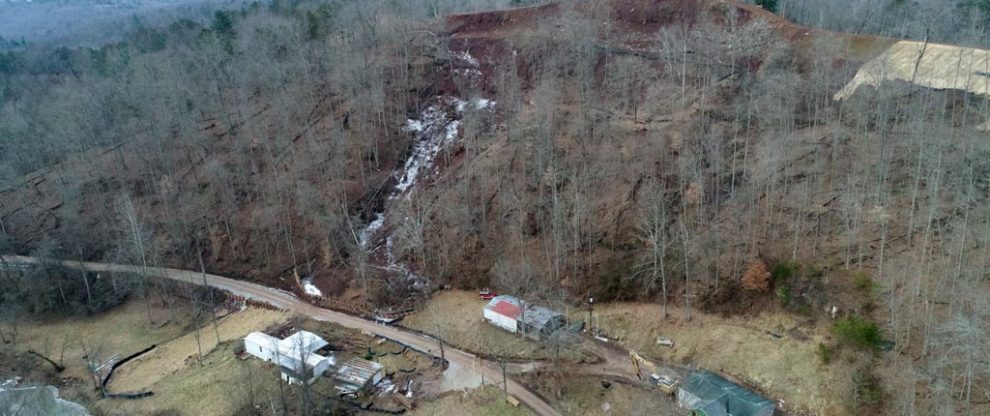
Impoundment, an expansive, 72-acre body of water and sludge
visible to the residents below only via an occasional aerial shot
in newspapers or on television. When the bottom gave way, more than 300 million gallons of
thick, black, suffocating wastewater poured into streams, homes
and wells. Chapman’s 14-year-old daughter, Paige, was too frightened to
sleep in her first-floor bedroom after the slurry came. Before she
left, she tossed a rock in the creek and waited, a long time, for
it to sink. Added local high-school teacher Mickey McCoy, "Around
here, you didn’t have to be Jesus Christ to walk on water."
Political fallout The subsequent federal investigation into the spill, launched
in the waning days of the Clinton administration and completed
after President Bush took office, has become a bitter controversy
marked by allegations of political favoritism, negligence and
indifference to the plight of a poor county. "The democracy thing? It isn’t working," said
McCoy’s wife, Nina. "Here, our democracy is being held
hostage by our capitalism." To many people in eastern Kentucky, West Virginia and
southeastern Ohio, proof that corporate interests trump community
came with the recent fall of Jack Spadaro, a federal mine-safety
official whose 36-year career unraveled after he refused to sign
off on what he called "a whitewash" report on the Martin
County spill. Spadaro, then the head of the National Mine Health and Safety
Academy, says he and other investigators discovered negligence on
the part of Martin County Coal — a subsidiary of coal giant
Massey Energy Co. — and lax enforcement by the federal Mine
Safety and Health Administration. The slurry pond had a spill in 1994, Spadaro says, and the
company knew another break was nearly inevitable. "There was only 15 feet of soil and rock between the mine
and the slurry when it broke," said Spadaro, who also
investigated the Buffalo Creek disaster. "There should have
been 150." Massey disputes allegations that it knew another spill was
imminent, saying the claim is "completely false" and
that the company follows safety standards that exceed state and
federal requirements. Spadaro’s former boss at Mine Safety, Davitt McAteer, defends
Spadaro. McAteer told 60 Minutes this year that major fatalities
were avoided only "by the grace of God," and that
officials expected a report that recommended violations, fines and
possible criminal charges. "All of a sudden, in January 2001, on Inauguration Day, it
changed," said Spadaro, who turns 56 on Monday, the
anniversary of the spill. "The Bush people came in and
stopped the investigation. They said it had gone on long
enough." McAteer was replaced and Spadaro — accused of abusing his
authority and misusing a government credit card, resulting in
$22.60 in bank fees — was reassigned to a "Jack got a raw deal, no question," said Tom
FitzGerald, of the Kentucky Resources Council. "He ran afoul
of a new administration, one whose environmental policy and energy
policy are the moral equivalent of the portfolios of George Bush
and Dick Cheney." Spokesmen for Mine Safety said that, although they do not
comment on personnel matters, there is more to Spadaro’s case
than he says. Officials also said that he was denied federal
whistle-blower status. That hardly mattered to Spadaro’s cheering supporters Oct. 2
at the Blue Gator in Established by Terry Anderson — a Democratic Ohio Senate
candidate who was held hostage in Lebanon for for almost seven
years after being kidnapped in 1985 — the foundation is named
for the Rev. Lawrence Martin Jenco, a now-deceased Roman Catholic
priest held hostage with Anderson. Low expectations Mickey and Nina McCoy believe that dignity is insulted
virtually every day. "We’re supposed to sacrifice The McCoys and others were dismayed again this year when an
administrative judge in Massey, the fourth-largest coal company in Mrs. McCoy, a high-school biology teacher, has begged for more
studies on contamination of the local water supply but thinks it
won’t happen. "The EPA let the coal company conduct the tests," she
said. "Regulatory agencies who came in here after the spill
set up shop on coalcompany property. The watchdogs became guard
dogs." Massey did, however, bear the cost of the cleanup, estimated at
$46 million. It also paid the The company maintains that slurry is a benign, nontoxic
substance, no more dangerous than dirt. During a raucous public meeting in April, a Kentucky Coal
Association representative became angry and offered to eat some.
Mr. McCoy, a citizen panelist at the meeting, has a jar of slurry
saved in case the man decides to follow through. "It was like Jerry Springer," said Mrs. McCoy,
exasperated. In the four years since the spill, which temporarily shut down
five water-treatment plants as its black plume moved to the Ohio
River, bottled water has become the largest section of the local
grocery, she said. Environmentalists continue to push for improved regulation of
mammoth slurry dams, hundreds of which dot the nation. "There
are 223 more of these in Massey says the area has healed and been "reclaimed."
But Chapman says he’s still waiting and watching for fish —
wildlife officials say the slurry killed an estimated 1.6 million
in more than 70 miles of stream — to return to his stretch of
Coldwater. He used to see mink and muskrat, too. "I am not against coal mining, and neither are most people
here," he said. "I don’t even know that we need new
laws. How ’bout we use the ones we have?" rprice@dispatch.com
|
|||||||||||||||||||||||
|
||||||||||||||||||||||||