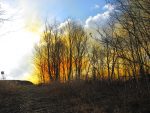
Cut and run
  The most diverse forest
  Three different forest
    areas

  Four seasons
  Colorful fall season
  Flowers galore
  Endangered species
  Lots of forests
  Cutting down the trees
  Forest fun
  Acid Rain

Cut and Run

      Landholders. Since colonial times western Virginia (now West Virginia) land has been owned or claimed by a small number of privileged speculators - originally by wealthy English merchants and the Virginia planter aristocracy. Later on, local elites, who managed the land for absentee owners, influenced the Virginia Assembly to void the early colonial land claims.  Once statehood arrived, these local elites - lawyers and businessmen, eager to bring on development, aided "outsiders" to accumulate large land holdings. 

     Those outsiders remain: railroads, coal operators, and timber companies.  Make no mistake about it, the arrival of the railroads, whose powerful engines could move great quantities of logs from the mountains, spelled doom for West Virginia's primeval forests.  

      Clearcutting. The mentality of that era may sound familiar:   "cut and run."  And so they did. Timber production reached its zenith in 1909 at 1.473 billion board feet. Compare Kentucky's maximum lumber production, which occurred in 1907, of 912,908 board feet. By 1920 much of West Virginia resembled what one can see in present-day clearcut areas of Oregon's mountainous landscape.  

     The oldest and largest hardwood forest in our country was wiped away by laissez-faire capitalism. Thirty billion board feet of lumber and an equal amount of pulpwood, along with 98 percent of the profit, left the state. As author John O'Brien notes in At Home in the Heart of Appalachia, "this was enough wood to build a thirteen-foot-wide, two-inch-thick walkway to the moon." By the 1930s three-quarters of West Virginia's land mass and ninety percent of its natural resources were owned by the outsiders.

     With the trees gone the people in logging camps and mill towns vanished.

      There was a degree of class conflict in this picture:  farmers, other small landowners, and small townspeople versus the industrialists, such as Davis and Elkins, and their allies who included state supreme court justices and some politicans.  Ronald L. Lewis' Transforming the Appalachian Countryside:  Railroads, Deforestation, and Social Change in West Virgnia 1880 - 1920 (University of North Carolina Press 1998) is a cogent examination of the era. 

     Flooding. Denuded mountains contribute to flooding. In the first three decades of the twentieth century prominent West Virginia authors spoke on that topic. A.B. Brooks in 1911 observed that forests "hold the water of rains and melting snow and give it out gradually to the springs and regulate the flow of creeks and rivers." Modern research at the USDA Forest Service's Fernow Experimental Forest in West Virginia shows that forests retain water through the process of evapotranspiration, which process reduces flooding.

      In 1921 a handbook published by the Society of American Foresters concluded that the devastating flood of 1907 "was a direct result of the cutting of timber." In 1908 the West Virginia Conservation Commission stated: "The increase of total discharge of West Virginia rivers, in spite of diminishing rainfall...is due solely, so far as available data can be interpreted, to deforestation of the mountains."

     Current timber related flooding photos may be seen at Penny Loeb's site: http://www.wvcoalfield.com

     Virgin timber. Today one can find a few patches of virgin hemlock trees in the Mountain State, such as Cathedral State Park in Preston County and a virgin hemlock trail near Interstate 68 outside of Morgantown. On North Fork Mountain in Pendleton County stands virgin red pine in an area protected by The Nature Conservancy.  To find out more about old growth forests in West Virginia you can access http://wvnvm.wvnet.edu/...
 
     Second growth. Although huge trees are gone in West Virginia, sufficient time has passed for native forests to have regenerated in a smaller and beautiful fashion. The Monongahela National Forest , composing about 900,000 acres, mostly is older second growth starting to develop old-growth attributes. Of interest is the fact that the "Mon," as it is called, like the mythological Phoenix, rose from destruction. The national forest was created by the purchase of cut and burnt private lands no longer suitable for farming and having little economic value.

     Some clearcut areas have never recovered, though. An impenetrable wilderness of 500,000 acres thick with red spruce at high elevations, lost its organic soil through burning. One intriguing remainder is Dolly Sods but little red spruce. Perched on the crest of the Allegheny range, Dolly Sods Wilderness Area composes one-third of the 32,000-acre Dolly Sods region. Largely barren and windswept, resilient plants like fire cherry, bracken fern, and the heaths have reclaimed much of the broken landscape. An informative article appears in the Sept.-Oct. 2001 Sierra magazine.

     The end result of the maturation of second-growth hardwoods is an ever-growing, irresistible temptation in the timbering and woods products industries to cut more and more. What kind of timber?
Last updated on Tuesday, September 11, 2001