|
|
|
|
|
|
This news story originally provided by
The
Lexington Herald-Leader
August 8, 2005
Coal industry's models of success are just false
fronts
By Bob Sloan
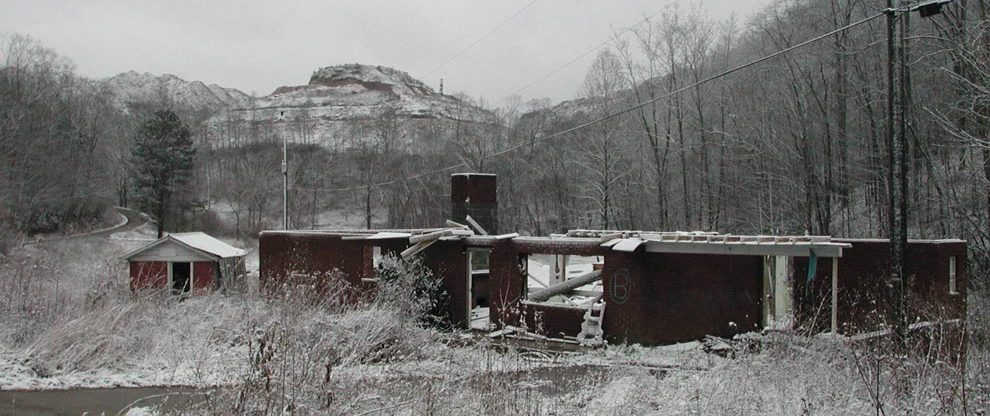
Some people try to defend mountaintop removal coal mining, the
shameful practice of reducing forested hills to dead heaps of rock,
to reach thin seams of coal. It's the cheapest way to mine coal
these days, partly because it requires very few workers.
These defenders of mountaintop-removal mining nearly always mention
StoneCrest Golf Course in Floyd County as an example of how a mining
site can be rehabilitated.
I never thought anything related to mountaintop removal would remind
me of college history classes from 40 years ago, but whenever I hear
about that golf course, I can almost hear a professor lecturing to a
bunch of half-attentive students about "Potemkin villages."
He told us that when Catherine was empress of Russia in the early
1700s, she heard rumors that things weren't quite right in some
newly acquired territories. She decided she should see for herself.
The rumors were true. Peasants were angry, there was resistance to
her government and a few royal heads might roll if the empress found
out how bad things were on the new Russian frontier.
Before her tour, a smart prince named Grigory Potemkin imported a
few hundred well-fed Swedish and German farmers into the Crimea. He
set them up with free land and new houses and cleaned up the few
villages Catherine was likely to see up close. What he couldn't
sanitize, he hid with fences and trees. Those projects became known
as "Potemkin villages."
And they worked: Catherine did her big tour and went back to Moscow
convinced things were just hunky-dory out there in the Crimea.
The coal industry has its own version of a Potemkin village with the
golf course in Floyd County. StoneCrest claims on its Web site to be
700 acres of reclaimed mountaintop removal that has been
successfully developed. I've seen pictures of it, and it's
beautiful. It's also one of a kind.
Seven hundred acres is about 30.5 million square feet. A StoneCrest
groundskeeper told me the intent was to put 6 inches of topsoil on
the dead ground left by the coal operation. That's right at 600,000
cubic yards of dirt; delivering it would require 38,500 double-axle,
six-wheel dump trucks, more or less.
The coal industry thinks we're dumb enough to believe somebody would
bring that much dirt to cover up the destruction of a mountain more
than once.
The coal industry has other Potemkin villages. One is the federal
prison in Martin County, built on a former mountaintop removal site.
Defenders of the mining method are pleased to describe the prison as
reclaimed land put to good use. The implication seems to be that
Kentucky ought to be thinking of penitentiaries as a new growth
industry, to fill up empty dead places where mountains once rose.
But the supporters don't talk much about how the project went $60
million over budget, due mostly to buildings settling. That
devastated ground just can't support anything that heavy.
And they don't mention the nickname locals pinned to their new pen:
"Sink Sink."
Defenders of mountaintop removal will point to the new Lowe's store
in Hazard. But they won't say anything about how it stood empty for
at least six months longer than expected. It took that long for
engineers to figure out what to do about the fact the new building
began sinking into the dead ground on which it was erected as soon
as the walls went up.
Empress Catherine probably got fooled because she wanted to believe
everything was just fine with her empire. When that shrewd prince
told her where to cast her eyes, she didn't bother to look past his
prettified towns and imported farmers to see the disorder and
rebellion beyond them.
The coal industry, determined to get to its version of black gold in
the cheapest way possible, doesn't want the people of Kentucky to
look beyond a golf course, a prison or a new Lowe's store.
But I think they will.
Bob Sloan of Rowan County is an author and former Herald-Leader
contributing columnist.
|
|
|