Mountaintop removal coal mining and the "clean coal" oxymoron Stop mountain top removal coal mining - Ohio Valley Environmental Coalition

Fair Use Notice


This news story originally provided by AP through The  Charleston Daily Mail

8/9/2003

Massey claims endangered species study delayed permit, force layoffs

CHARLESTON, W.Va. (AP) -- A Massey Energy subsidiary has laid off 24 miners, saying federally required studies on an endangered species have held up expansion of a Logan County surface mine.

Alex Energy's North Surface Mine in Holden was required to determine if the endangered Indiana bat lives in the proposed mining area as part of its application to reauthorize its U.S. Army Corps of Engineers' permit for a valley fill, Massey spokesman Jeff Gillenwater said Friday.

The mine employs 120 miners and those who were laid off would have been used in expanding the 300-acre operation, Gillenwater said.

Massey Chairman and CEO Don Blankenship said the survey revealed the bats do not live in the area.

"It is unfortunate that laws and policies that require us to conduct studies on Indiana bats, even though none have ever been found in the area, should cause delays that cost West Virginia jobs particularly in a case such as this when it does nothing to protect the environment,'' Blankenship said in a prepared statement.

The survey results were submitted to the corps, which then forwarded them to the U.S. Fish and Wildlife Service on July 22.

Corps spokesman Chuck Minsker said Friday that the permit has not been delayed.

"It should be sent out pretty soon,'' Minsker said.


This news story originally provided by The Register-Herald

8/11/2003

Heavy weight on DOH's shoulders
By Mannix Porterfield/REGISTER-HERALD REPORTER

A key to letting coal trucks tipping the scales at a maximum 120,000 pounds rumble across southern West Virginia roads is making sure bridges can handle the increased weight.

Toward that end, the Division of Highways is surveying some 600 bridges to see which can handle the added stress.

In Kentucky, a mechanical engineer who became involved in the controversy after helping to forge the Ohio Valley Environmental Council doubts that many bridges can either past muster now, or can be upgraded to satisfy safety needs.

"As an engineer, I know they've got a burden of responsibility for public safety," says Dave Cooper of Lexington.

"And it's a heavy burden. I don't believe these engineers are just going to upgrade bridges that don't meet safety standards. They're not going to do it because they have to sleep at night."

Cooper says one of them told him the weight limit isn't posted now on a bridge if it is rated for the same poundage as the road.

"Only when a bridge has less weight capability than the road is the only time they post it," he said.

As other engineers have commented at DOH workshops in advance of designating coal resource roads in the 15 counties specified in this year's new truck safety law, there is no fear of a sudden collapse of a bridge.

Rather, concern is couched in the diminished life of a bridge by the constant wear of heavier loads.

One engineer put it this way, "Instead of having a bridge last 50 to 60 years, you're cutting its life span to 15 or 20 years."

And therein lies a major concern - the added cost of upkeep or replacement.

"You can't look at concrete beams and see the early warning signs of failure," Cooper said. "You can't see the rust or cracks like you can with a metal beam."

"There is really no good way to inspect them," Cooper said. "It's pretty amazing to me that a bridge can be upgraded from 24,000 pounds to 65,000 pounds by just welding on a few extra beams, especially given the rust and deterioration of this span."

Figures on replacing bridges vary with size and materials, ranging from $300,00 to $500,000.

"Who's going to pay for all this?" Cooper asked. "West Virginia, like Kentucky, is having real budget problems."

Even if a bridge is upgraded, Cooper suggested the change could merely be cosmetic with no real beefing up.

For instance, he points to a bridge in Stollings, Logan County, heavily traveled and frequently used by school buses. From a standpoint of rust, it is deteriorating, he said.

"What they did was weld some beams on the underside," he said. "That was the upgrade. And presto, magic, it goes from being a 12-ton bridge to a 40-ton bridge, or unlimited."

No longer involved with OVEC, which he organized, Cooper pointed to the main coal-haulage road in Kentucky, four-laned US. 2.3. running alongside the Big Sandy River.

"Everyone of those trucks is piled up with graveyard humps," he said. "To me, that says they're all running well over 120,000 (the limit in that state). I wouldn't be surprised if quite a few were at 200,000. It's just piled up to the sky."

Cooper likened the stress of added weight on bridges to that of an aluminum can.

"You can bend it a few times, and nothing happens," he said. "But as you bend it back and forth, it breaks. That's metal fatigue."

When he spies a coal truck in his rearview mirror, Cooper says he automatically exits the road.

"I know they can't stop," he said. "I just pull over and let them go past me. I just don't feel safe. I know that coal is important to the region and to the economy, but it's just chasing people out of southern West Virginia. People want to live where they feel safe."


8/18/2003

Katuah Earth First! Blockades Mountain Top Removal Site on Zeb Mountain in Campbell County, TN

Elk Valley (near LaFollette, TN) - Early Monday morning (Aug. 18, 2003), environmental activists with Katuah Earth First! have blockaded the entrance to the Zeb Mountain coal removal operation in scenic Elk Valley in Campbell County, TN. Three activists have their arms chained inside concrete filled barrels across the access road in an attempt to halt the destruction of Zeb Mountain. Two activists have climbed 100' to drop two banners from a giant billboard on I-75 protesting the new mining practice of mountain top removal. The activists intend to stay all day.

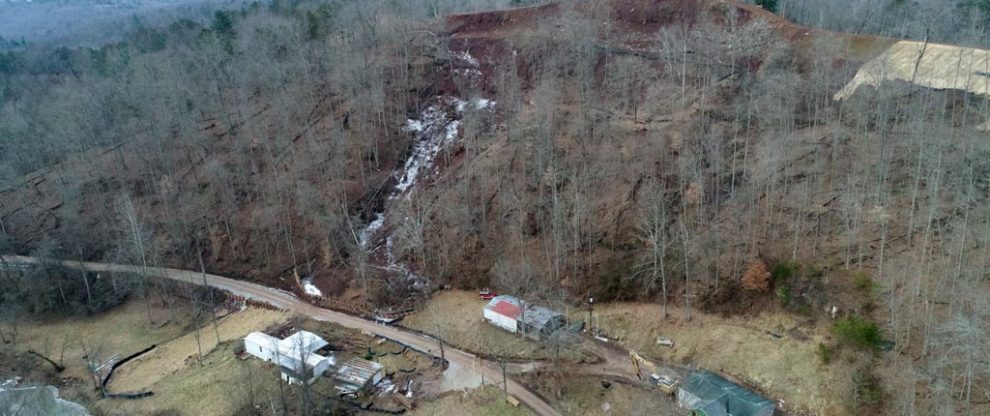
Mountain top removal is just what the name implies, the mountain top is blown up and bulldozed into adjacent valleys in order to get to a thin layer of coal. This project will devour three peaks of Zeb Mountain, over 2100 acres of forest habitat.

"If the coal industry is successful in forcing this mountain top removal project on Zeb Mountain and Elk Valley, the whole Cumberland Plateau will be open to this destructive practice" said john johnson of Katuah Earth First! "This project will destroy habitat for a number of endangered species such as the black sided dace (a small fish), the Indiana Bat, and several freshwater mussels. It will also destroy streams, forests and mountains that are still trying to recover from past logging and mining abuses" added johnson, who lives on the side of the Cumberland Plateau near Dunlap, TN.

"There is an open conspiracy among the coal industry, the Tennessee Valley Authority, the Tennessee Department of Environment and Conservation, and the Office of Surface Mining to jump start dangerous and destructive mountain top removal practices in Tennessee for private profit and to provide high sulfur coal for TVA to burn at their coal facilities with new scrubbers" said Meagan Carter of Katuah Earth First! "This will lead to flattened mountains, decimated forests, polluted streams and more air pollution" she added.

"Mountain top removal has already terrorized West Virginia. It typically uses 100 times the amount of explosives used in the Oklahoma City bombing, more than enough to cause serious structural damage to surrounding homes and churches" said Alex Solomon, a native of West Virginia and current University of Tennessee Law student. "In 2001, flooding and mudslides from mountain top removal practices caused the death of two West Virginians and the destruction of 3500 homes in Dorothy, West Virginia" she added.

Katuah Earth First! demands an unconditional end to destructive coal mining practices and immediate protection for communities, forests, rivers, mountains and rare, threatened, and endangered species. Katuah Earth First! also demands that the permit for mountain top removal given to the Robert Clear Coal Corporation be immediately revoked and their corporate charter revoked for past violations.

Katuah Earth First! calls on all citizens up and down the Tennessee Valley and the Cumberland Plateau to stand up and demand an end to destructive coal mining that ruins nature, culture and mountain heritage.

"The coal companies are corporate carpetbaggers who have historically cheated people out of their land, trashed the area, exploited local workers and sent all profits up north and overseas" said Chris Irwin, a sixth generation Tennessean active with Katuah Earth First!

This project will create only 40 temporary jobs and destroy Zeb Mountain - ruining hunting, fishing, hiking, horseback riding and other outdoor opportunities. Outdoor recreation and tourism provide more long term economic benefits than do short term resource extraction.

Visit the website: http://www.angelfire.com/rebellion2/zebmountain


8/21/03

DEP mining director Matt Crum resigns

The state's mining director resigned today, ending a two- year tenure with the West Virginia Department of Environmental Protection.

Matthew B. Crum's last day as director of the Division of Mining and Reclamation will be September 5, 2003, but he will remain on staff in an advisory capacity until November 1. He has served as mining director since June 2001.

DEP Cabinet Secretary Stephanie R. Timmermeyer has asked Joe Parker to serve as the division's acting director. Parker is a deputy director in DMR's Oak Hill field office. He has 37 years of experience in state government.


This news story originally provided by WV Metro News

8/26/03

DEP Secretary Explains Decision
Staff
Charleston

The Secretary of the state Department of Environmental Protection says her decision to replace Division of Mining Director Matt Crum was totally her decision, not forced on her by the coal industry or the Wise Administration.

DEP Secretary Stephanie Timmermyer asked Mining Director Matt Crum to resign during a meeting last Thursday. Crum was hired under former DEP chief Mike Callaghan. Crum made several decisions that upset the state's largest coal producer, Massey Energy.

Secretary Timmermyer tells MetroNews her decision has to do with Crum's management style and communication difficulties between them. Timmermyer says she took six months to evaluate the division directors directly under her and found it necessary to make the one change.

Timmermyer says she received complaints about Crum, but those weren't factored into her final decision. She says she receives complaints about all her directors from various groups. Timmermyer says the final decision rests with her and she made it alone. She says there was neither pressure from the industry nor the Wise Administration to make the change.

Secretary Timmermyer says she'll spend more time in the Division of Mining in the months ahead. She says the permitting process is more complex than in other divisions. Timmermyer says she wants to review several policy issues with acting director Joe Parker.

Timmermyer says she has no plans to fill the position permanently because it's an "awkward time" because the Wise Administration will be out at the end of 2004. Timmermyer admits she doesn't know what will happen with her own job when a new governor takes office.

Timmermyer says the goal is for the Division of Mining is to promote balance. She says the key is to mine coal in the most environmentally sound way possible.


This news story originally provided by WV Metro News

08/26/03 

Environmentalists Angry over Crum Dismissal
Staff 
Charleston

Environmental activists in West Virginia are furious over the recent dismissal of DEP Mining Director Matt Crum. About 20 protestors showed up at the doorstep of the DEP'S Charleston office Tuesday morning asking for an explanation from DEP Secretary Stephanie Timmermeyer. They got a message from DEP Assistant Secretary Randy Huffman.

Huffman delivered a statement from Timmermeyer expressing her regrets that she could not join them today because she was in meetings. Huffman promised Timmermeyer would be willing to meet if an appointment was scheduled. The answers didn't sit well with the protestors.

"Who's more important the people she's meeting with or the people she's hired to protect?" Yelled one protestor.

Huffman informed the group that Timmermeyer was working with the mining staff at the Nitro office. The group decided to move its protest there. The group vented their frustrations over Crum's dismissal to Huffman.

"There's nobody else in this state that can take that position over and do the job that Matt Crum can do." Said protestor Elaine Perkey of Lincoln County. "We've grown to trust him. That man will use the law in situations where nobody else even read it before."

While they demanded answers, it was clear the environmental protestors believe the coal industry is behind Crum's abrupt dismissal.

"Mr. Crum was the only one that ever did enforce the law against the coal companies." Says Patty Sebok of Seth. "I don't know if they (the coal industry) forced him out or not, but I think they definitely had a hand in on it."

Timmermeyer tells MetroNews Crum's dismissal was a result of a conflict in management style and a lack of communication. Sebok thinks the reasons are deeper and Timmermeyer doesn't want to tell the truth. Sebok and other believe Crum's efforts to implement three new policy changes on mining were the reason for his demise.

Specifically, the groups believe Crum's support of research to reestablish hardwood forests on reclaimed lands, reducing the size of valley fills, and new policies on acid mine drainage cleanup are likely the reasons for his dismissal.

Timmermeyer says no permanent replacement for Crum is expected since the Wise Administration will be gone in just over a year. During the interim, she and assistant Joe Parker will handle the day-to-day duties of the mining director's position.


This news story originally provided by AP through The  Charleston Daily Mail

08/26/03 

DEP's Crum leaves post immediately

CHARLESTON, W.Va. (AP) -- Environmental Protection Secretary Environmental Protection Secretary Stephanie Timmermeyer has revoked an agreement that would have allowed former State Mining and Reclamation Director Matthew B. Crum to stay on through November.

When Timmermeyer asked Crum to resign early Friday, DEP said in a news release that Crum would remain mining director until Sept. 5, and continue with the agency as an adviser until Nov. 1.

By Friday evening, Timmermeyer had ordered Crum to clean out his Nitro office over the weekend, and never return to the building, DEP officials said.

"He's not staying on,'' said DEP chief of administration Randy Huffman, who passed on Timmermeyer's decision to Crum.

About two dozen coalfield residents and environmental activists protested Crum's firing Tuesday morning at DEP's Charleston headquarters. Timmermeyer was in Nitro meeting with mining and reclamation staff, but issued a statement through Huffman.

"I made a difficult personnel decision recently for the good of the agency and feel that it is now appropriate to move forward,'' Timmermeyer said.

On Monday, Huffman said Crum would remain on the DEP payroll temporarily, but not past Nov. 1.

"Stephanie rescinded the provision that would allow him to stay on as director until Sept. 5,'' said Huffman, who declined to explain why Timmermeyer rescinded that arrangement.

Timmermeyer did not immediately return phone calls seeking comment.

"The decision was sudden,'' Huffman said. "There was no reason to cut him off overnight.''

Crum, formerly an environmental lawyer with the U.S. Department of Justice, has headed the division for two years. He was named to the post in June 2001. He also had previously worked for the Nature Conservancy.

Crum was hired by former DEP Secretary Michael Callaghan at a time when the agency's mining enforcement authority was threatened with takeover by federal regulators who were concerned with inadequate enforcement.

Crum said he believes the agency accomplished a lot during his tenure.


This news story originally provided by The  Charleston Daily Mail

08/27/03

WISE TO RETURN $1.21M IN '04 CAMPAIGN FUNDS 88% CAME FROM BUSINESSES, LAWYERS

When he announced he would not seek re-election in 2004, Gov. Bob Wise already had raised $1.21 million for that race.

Wise said he will return the money to the people who gave it to him, rather than donate it to a charitable organization, give it to a political party group or save it for another race. No candidate is allowed to keep any campaign funds for personal use.

Eighty-eight percent of the donations that could be identified came from businesses or corporate lawyers, according to a new analysis just completed by the West Virginia People's Election Reform Coalition.

Donors who gave a total of $130,237 could not be identified and classified by PERC researchers. State election laws do not require donors who give less than $250 to list their business or occupation.

This is the fourth election cycle where PERC has analyzed all donations given to candidates for statewide political office and for the Legislature. PERC will release its complete analysis of 2002 election donations by the end of the month.

Wise raised 44 percent of all the money that could be identified from donors associated with the industry, health-care, real estate and construction industries:

- Coal donated $186,400, 17 percent of the total.

- Health care (including physicians, hospital executives and chiropractors) donated $149,275, 14 percent of the total.

- Real estate, building- and highway-construction executives donated $137,350, 13 percent of the total.

Norm Steenstra, executive director of the West Virginia Citizen Action Group, said, "Wise had a million-dollar-plus war chest, thinking it would guarantee a second term.

"The amount of money in the political system continues to increase. The connection between donations and administration policies is as clear as a bell.

"Surprisingly, Wise backed coal's agenda on overweight trucks and received an amazing amount of cash from an industry that did not support him in 2000," Steenstra said.

Other top business-oriented donors who gave to Wise after his 2000 victory included:

- Corporate lawyers, $93,950.

- Manufacturing and chemical companies, $56,550.

- Banking and finance, $55,450.

- Gambling, $47,500.

- Transportation, $21,700.

- Pharmaceuticals, $19,750.

- Oil and gas, $17,800.

- Communications, $16,500.

- Business legislative lobbyists, $11,750.

Contributors identified with labor unions and liberal organizations accounted for a pittance of the total contributions Wise had raised after being in office for two-and-a-half years.

These groups accounted for a little more than 2 percent of all the money coming from donors who could be identified by PERC researchers:

- Consumer and trial lawyers, $15,250.

- Teachers unions, including the West Virginia Education Association and West Virginia Federation of Teachers, $11,500.

- Other labor unions, $2,000.

- Social-issue groups, $1,000.

State law restricts each individual donor and each political action committee to making a $1,000 donation during a primary election and another $1,000 during a general election.

Gary Zuckett, a PERC researcher, said, "The majority of donations Wise received after he was elected in 2000 reflect policies he has pushed relating to overweight coal trucks, so-called 'tort reform,' limiting medical-malpractice victims' rights, economic development giveaways and workers' compensation reforms.

"It leaves the public wondering how much public policy is determined by private contributions, especially when we see a similar trend with the Legislature. Coal and health-care interests are at the top of the list."

Zuckett specifically criticized the economic grants, totaling between $215 million and $240 million, which soon might be distributed by the state Economic Development Grant Committee. Those grants likely will include funds for a minor league baseball park in Charleston, the Pullman Square retail complex in Huntington, a Cabela's outdoor outlet mall outside Wheeling and racetracks in Quincy and Flatwoods.

Represented by lawyer Larry Harless, CAG successfully challenged the procedures used to award those grants last year. Next week, CAG likely will file another legal challenge after the grant committee makes its choices official.

"We didn't consider that economic development," Zuckett said. "We considered it Christmas in August."

To contact staff writer Paul J. Nyden, use e-mail or call 348-5164.


This news story originally provided by AP through The  Charleston Daily Mail

08/27/03

Massey Energy revises earnings forecast downward

RICHMOND, Va. (AP) -- Massey Energy Co. said Tuesday it expects to report no earnings or a loss for the third quarter instead of the profit it previously forecast.

The coal mining company said it now expects to report earnings per share for the quarter in a range between zero and a loss of 12 cents. Previously, the company had said it expected a profit between 8 and 18 cents a share for the September quarter.

Massey, which is West Virginia's largest coal producer, blamed lower productivity and slower shipments for the shortfall. The company previously had said it expected shipments for the quarter to reach 10.5 million-11.5 million tons, but now that total is expected to reach only 10.3 million-10.7 million tons.

In a news release, chairman and chief executive officer Don L. Blankenship said the company is "currently seeing improvement'' and expects the fourth quarter's results to be better.

Massey's stock closed Tuesday at $12.07 a share, down 11 cents, or 1 percent. The revised earnings forecast was released after the stock market closed.


   Smart Counter Details   OVEC Home   Issues   Contact   Join   Site Map