The People Comment Passionately On
Mountaintop
Removal Coal Mining
July 24, 2003
Photos by Vivian Stockman
Page 1
See sidebar for links to other pages and news
Scroll down for photos
Note:
The comment period on the EIS
has been extended to January 6, 2004
The Public Hearing on the Draft Environmental Impact Statement
As part of the
comment
period on the draft
Environmental Impact Statement (EIS) on mountaintop removal / valley
fill coal mining (MTR), several agencies that are supposed to regulate
the mining industry hosted a public hearing in the Charleston Civic
Center on Thursday, July 24. The hearing consisted of two separate
sessions, one from 2-5 p.m. and another from 7-11 p.m.
(You have
until Aug. 29, 2003 to submit
written comments on the EIS. As a FYI, the 5,000-page EIS weighs almost 40
pounds and stands about 30 inches high when each of the 8.5 by 11 inch
volumes are stacked up. Happy reading! We hope to soon post to the
website a summary of points that you can use to make your own comments.
Be sure to see the EIS
summary from Kentuckians For The Commonwealth.)
Coal industry
folks dominated the first session of the public hearing, with only a
handful of coalfield residents and other Stop Mountaintop Removal
activists in attendance, as we had planned to make a strong showing in
the second session. We did just that, with opponents of MTR
outnumbering the proponents by three to one!
In order to
get their five minutes to comment, people had to sign-in on registration
cards. These cards were supposedly then passed to the moderator in the
order they were received, so folks would get their turn to speak according to
the order in which they signed the cards.
In the afternoon
session, the first
speaker was Bill Raney, president of the West Virginia Coal Association.
Strange how he always manages to be the first to speak at these types of
things, despite the first-come, first-served sign-up process. Ole Raney
is slipping up--he only mentioned the word "proud" five times.
He's proud of the 14,000 coal mining jobs left (the coal industry itself
says about 2,000 of the jobs are on MTR sites), which is fair enough.
But, is he also proud of the huge mountaintop removal machines that have
taken thousands of coal miners jobs? He didn't tell us that.
In the
afternoon session, most speakers trotted out the standard coal industry
arguments: jobs OR the environment; we need more flat land; if
some flooding isn't caused by mountaintop removal, then no flooding is;
West Virginia IS coal; without mountaintop removal, we'd be
screwed. For arguments that debunk these standard, yet absurd,
industry opinions, please read peoples' comments in the sidebar.
Before the
evening session, about 50 of us met near the Civic Center to march en
masse to the hearing. Outside the Center, we met up with about 30
other Friends of the Mountains. We visited with one another as we waited for the doors to open.
As our folks
were beginning to go inside, I noticed Bill Raney and Chris Hamilton,
vice president of the WV Coal Association, walking up
to the venue. Bill didn't see me. I heard him speak to Rod
Blackstone, an aide to Charleston's mayor. Referring to our
friendly folks, Raney asked Blackstone, "Why did you let all these
damn people come?"
"Damn
people, Bill?" I asked Raney, who looked a little surprised to see
me standing there.
"Now,
Vivian, I was just joking. I call myself damn, too," Raney
stammered.
Blackstone
piped in then, saying of course it was just a joke.
I didn't find
it too funny. But, our folks were filing inside, and I went in, too. Many
opponents of mountaintop removal were the first to sign-up to speak for
the evening session.
Yet, strangely, the second person to speak that night was Chris Hamilton, who had been standing outside while our
folks were signing up. He definitely was not first in the sign-up
lines. Curiously, at least
three well-known opponents of mountaintop removal, who were among the
very first to sign-up, had to wait and wait and wait for their turns.
Despite the obvious injustice, those three MTR opponents didn't
really mind waiting, as they got to listen to speaker after speaker from
our side, each of whom was totally riveting.
We were elated.
Coalfield residents, including several who had never spoken out in public before, got up and
told the tale of what is happening to their homes, communities and mountains.
The people in attendance who are fooling themselves into believing there
is nothing wrong with MTR had to listen to our impassioned and informed
speeches! The look-the-other-way regulators had to listen to us, too!
Click on the comments in the sidebar to read the statements made that
evening.
Elaine Purkey
brought tears to people's eyes when, for her statement, she sang
"Larry's Song." That song will be on the upcoming music CD about
mountaintop removal. Novelist and lay preacher Denise Giardina also made
outstanding comments, delivered as a sermon, which must have made some MTR apologists tremble.
"It was a
privilege to hear the well-crafted words and feel the heart-felt
sentiment of persons directly in the line of fire of the coal pillagers.
These dedicated environmentalists and concerned citizens of a raped and
diminishing West Virginia left no ugly stone unturned as they clearly
presented not just the injustice being done, but the simple, how-be-it
ignored solution: ban mountaintop removal and enforce coal laws already
on the books. I am so impressed," Sandy Brady e-mailed after the
hearing.
Chuck Wyrostok
emailed, "One of the things that
struck me was the coalfield residents mentioning several times to the
agency reps that they (the residents) had never been visited, contacted
or witnessed anyone examining MTR. How could you do an EIS without ever
talking to anyone that lives there? Seems
like the government doesn't want to experience the real deal, eh?"
Kathryn Stone
e-mailed, "I felt as though I had attended a 'revival' meeting last
night as a true believer and 'got the call' (or whatever the expression
is!). Wow!
I cannot help but believe that the consciences of some of the
proponents of EIS were affected by those powerful speeches.
Of course, they had to parrot the same old lines, but I thought I
detected some deflation in tone. It definitely was a coalfield/environmentalist evening.
What a great bunch of folks we have!"
Joan
Mulhern, with Earthjustice in DC e-mailed, "It looks to me from the
reports I have seen that everyone did a fantastic job of organizing for
both hearings -- there were people speaking out, whatever the odds,
about the travesty of mountaintop removal.
And that it had an impact on the federal officials listening.
"I
talked to several people on the Hill late this week who saw some of the
stories, and I think it was very positive, from the inside-the-beltway
perspective, anyway -- they saw (again) that there are people standing
up for their rights, their communities, and their environment.
That is so important.
I hope everyone who participated feels good about it; I think
everyone did great work."
Remember
to get your comments on the EIS in by August
29. Below are some photos
from the EIS hearings.

After the afternoon session, Boone County resident Maria Pitzer shows filmmaker Bob Gates photos of the damage her home sustained in recent
MTR-related flooding.

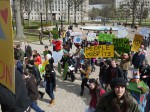
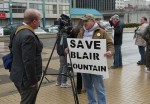
People begin to gather for our march over to the Civic Center.

If there were truth in government labeling, EIS
wouldn't just stand for Environmental Impact Statement.

The people march to the Civic Center.
Page 1
See sidebar for links to other pages
and news
|