The People Comment Passionately On
Mountaintop
Removal Coal Mining
July 24, 2003
Miscellaneous Comments
Flat Land Myth
The EIS needs to better address the following points.
You'll hear a lot of comments tonight about how great mountaintop removal is for the state because it provides flat land for economic development projects.
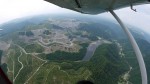
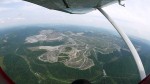
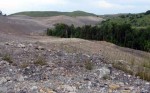
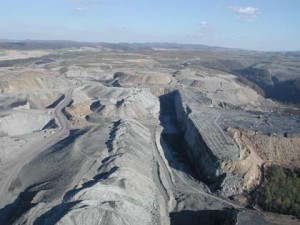
How can that possibly be true? Right now, we have 300,000 acres of blown-up, treeless, soil-less, rubble-strewn former mountaintops just waiting for the long-touted economic development. These wastelands have some ponds with stagnant water, not to mention the coal waste sludge lakes, but a good supply of fresh water, one essential for economic development, just isn't available because the blasting has wreaked havoc on the groundwater. Remember too, that these flat lands the industry touts are hundreds of feet above any existing municipal roads and other infrastructure. Former DEP head Michael Callaghan admitted that less than 2 percent of the sites that have already been obliterated by mountaintop removal have been developed.
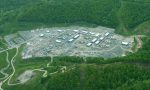
Yes, there are some projects on MTR sites, but why in heavens name do we need any more if we have over 300,000 acres sitting around? We do have a couple of golf courses, a high school whose gym sank and some jails that also have stability problems. For instance, over in Kentucky, $40 million of taxpayer money has gone into stabilizing the shifting rubble of a blasted mountaintop for the construction of the Big Sandy federal penitentiary. Now the guard towers at this showcase mountaintop removal economic development site are leaning!
At last year's Coal Summit in this very location, hydrogeologist Rick Eades noted that in the Coal River Basin alone there are about 95,000 acres of obliterated mountaintops and buried valleys. That is enough flat land to provide all of the following:
--5 5,000-acre Recreational Parks (25,000 acres)
--10 1,000-acre Prison Sites (10,000 acres)
--50 500-acre Shopping Malls (25,000 acres)
--100 100-acre Trailer Parks to relocate MTR-induced flood victims (10,000 acres)
--400 50-acre School Sites (20,000 acres) (Not that there will be any students left as mountaintop removal continues to destroy entire communities.)
--That would still leave about 5,000 acres for construction of a Coal River monument to Bill Raney, president of the West Virginia Coal Association and chief mouthpiece for the coal industry's blather about how great the industry has been for West Virginia, one of the poorest states in the nation.
The EIS needs to address the fact that West Virginia already has way more barren, waterless, soil-less flatland than it needs.
"One
Percent" lie
One
distortion of the truth we will likely hear tonight is something the coal
industry loves to repeat. West Virginia Coal Association president Bill Raney
often says that mountaintop removal only affects one percent of the state. He
recently may have revised that figure up to two percent.
Remember,
mountaintop removal happens in southern West Virginia,
not in the north. Several years ago, CNN
reported that over 20 percent of the land mass in some counties has been
subject to mountaintop removal. It’s probably more now. We are talking about counties like Boone,
Logan and Mingo. This huge land
disturbance obviously creates massive problems—take the last few years’
flooding as an example. And remember that when the coal industry tells you how
much it puts into this state in terms of taxes—remember what we pay and pay and
pay to clean up after it.
The EIS needs to include a full accounting of all the tax
subsidies the coal industry gets. Remember the billion-dollar super tax credits
that were supposed to create jobs and instead were used to buy giant machines
that replaced loads of miners? The EIS should have a full accounting of all the
externalized costs associated with mountaintop removal.
This industry continues to pit working class people against
working class people, while whisking profits out of state and leaving us, our
children and our children’s children a fiscal, social and environmental bill
that will be impossible to pay.
Water
The draft EIS fails to adequately address the numerous ways in which
mountaintop removal impacts water, the most important natural resource
in this state. Water is becoming the most sought after natural resource
on the planet.
What mountaintop removal does to surface and groundwater is criminal
in terms of our future.
The General Accounting Office recently released a report saying that
the United States faces water shortages that could have (quote)
"severe economic, environmental and social impacts." (end
quote)
According to aquatic biologist Ben Stout, most streams in West
Virginia are not on the US Geologic Survey maps that are used in
permitting mountaintop removal mines. Ben has walked plenty of streams
that aren't on the maps, and his studies have found critters that
indicate perennial streams, even in streams labeled as ephemeral or
intermittent on maps.
In burying hollows with valley fills-more accurately called valley
DUMPS-the coal industry is annihilating all kinds of biologically
crucial fauna. Valley dumps destroy the energy and nutrient flow created
by headwater streams, thus endangering the balance and life of
downstream rivers.
Note that for every acre of valley dump, at the very least, two acres
of land surface are lost. That's because the steep natural terrain of
southern West Virginia has lots of nooks and crannies, which add surface
area and which are perfect habitat for biologically important critters.
Remember that forests and streams are intimately tied together in the
web of life. And remember that we humans are part of that web of life.
If we allow coal companies to continue to destroy the land and water
that sustain the forests and the rivers, then we allow the coal
companies to destroy our future.
The EIS should do a much better job of tabulating mountaintop removal
impacts to the incredibly valuable waters of this state. The EIS should
recommend ways to truly protect this most precious of natural resources.
Original Intent of the EIS
The original intent of the EIS as published in the Federal Register was, "to consider developing agency policies, guidance, and coordinated agency decision making processes to minimize, to the maximum extent practicable, the adverse environmental effects to waters of the United States and to fish and wildlife resources affected by mountaintop mining operations, and to environmental resources that could be affected by the size and location of excess spoil disposal sites in valley fills."
The draft EIS completely fails to fulfill it original intent. Back to the drawing board, people. Do your mission, and cut the political absurdities out of this. And put a moratorium on mountaintop removal while you come to the conclusions that scientific reality dictates.
War on the Mountains
The draft EIS fails to note that acts of environmental terrorism are being committed right here in Appalachia.
Some have been saying that we need to sacrifice West Virginia's mountains so that the nation can have cheap energy without relying on foreign sources of energy.
Author Dennis Burke, using government statistics, calculated that 2,500 tons of explosives are used against the Appalachian Mountains each day. That is, every four days, more explosives are used in mountaintop removal coal mining than were used in the post-9-11 bombing of Afghanistan in the hunt for Bin-Laden.
In the long run, no amount of bombing our own coalfields will give us homeland security. Our nation's energy appetite shouldn't and needn't drive us to justify such massive cruelties to people and the land that supports us.
There are alternatives. The World Watch Institute says that renewable, cleaner energy technologies are advanced enough to satisfy the world energy needs NOW. And that's without whole-hearted government support for research and development in these technologies. Just think what we could do if we had a Manhattan Project for alternative energies. World Watch says the main thing lacking in getting alternative energies in place is the political will.
Look at who funds the Bush administration's campaigns and you can find reason enough as to why that political will is lacking.
The EIS needs to expose the Bush administration's ties to the fossil-fuel energy industries, and it needs to recommend that we begin a full scale switch to alternative energy. Bring that industry to the coalfields. That way we can have jobs, as well as a future.
|