World Social Forum
Porto Alegre, Brazil
January 23 - 27, 2003
Report to Leadership for a Changing World
from Vivian Stockman, OVEC communications coordinator
Coming into the WSF
Dianne didn't leave her usual detailed message on my answering machine. "Call me," was all she said.
Oh no, I've forgotten some grant report, I'm thinking as I dial her number.
"Viv," she says, "do you want to go to Brazil?"
"I hate this job," I say, way joking.
When Dianne explains that Ford Foundation and the Advocacy Institute want to send Leadership for a Changing World award winners to the World Social Forum, and that I can go as a tag-along, through the award's Individual Learning Account money, I get really excited.
Last year my friend Mary Wildfire begged me to go with her to the World Social Forum. I couldn't rustle up the funds, nor could I see taking all that time off work. Even though it was obvious, at the very least to me, that globalization affects OVEC's work, we simply aren't focused on it. We haven't the staff, time, energy or funds to focus on
that monster looming just outside our field of sight.
It was Mary who dragged me into learning about globalization. She convinced me to go to the World Trade Organization protests and globalization teach-ins in Seattle in 1999. Work ok'ed my time off for this and subsequent World Bank and International Monetary Fund protests in D.C. that Mary and I attended. I went as an individual, not as an OVEC representative. These experiences were what I thought about as I prepared for the World Social Forum. After all, the WTO, IMF and World Bank promote the globalization of corporate power, at great expense to the environment, human rights, national sovereignty and democracy.
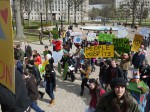
"This is what democracy looks like!" That was one of my favorites chants from N30, the Seattle protests. Democracy was people of every hue and age and walk-of-life out in the streets, chanting to the beat of ten-gallon-bucket drums and cow-bells, coming together over one overarching cause. As I wrote for our newsletter after the event, "Everybody had their pet issues, but they all boiled down to the demand that people and our life-supporting ecosystems be placed above the earth- and culture-destroying chase for profits by multi-national corporations."
Two things were stunning in Seattle: The power of unified people as we shut down the WTO's opening talks, and the unmasking of fascism in America. Martial law was essentially declared, and it wasn't to protect the people, it was to protect the global elites.
Here's another excerpt from my post-Seattle newsletter article:
The international speakers were captivating, but both Mary and I kept looking out the huge plate glass windows at the streets of Seattle, so obviously under martial law.
I felt like I was part of some testosterone movie. Troops of Robocops (in full riot gear) marched by. Then came black-clad battalions on motorcycle, followed by dark vans with flashing blue lights, then a couple of limousines, then more troops of cops. Discussing this later, Mary and I realized we were both thinking the same thing-all this military might is necessary to keep the WTO operating.
The WTO (was then) a five-year-old global trade bureaucracy that serves the interests of transnational corporations, functioning to move economic and political power away from national governments and into the hands of transnational corporations at a great cost to the environment, human rights and democracy. With 135 governments on board, the WTO seeks to reduce tariffs on trade and also non-tariff "barriers to trade," which could be anything that gets in the way of a transnational corporation's drive to make profits--like labor and environmental laws.
Under WTO, if a corporation determines that any law is a "trade barrier" it can sue. The case is brought before a secret tribunal of un-elected, corporate-retained judges who have the authority to overturn local, state and national laws and regulations. These rulings are enforceable through crippling trade sanctions.
So far, in its 5-year existence, the WTO has overturned every health, labor and environmental law that has been brought before the unaccountable tribunal.
Mary and I came home from Seattle radicalized. The earth's most powerful anti-democratic institution had been severely shaken by the power of the people!
It is overly simplistic, I suppose, but this crystallized for me in Seattle: The human world is divided into those who love life more than money and those who love money (and power) more than life.
Allow me to insert another excerpt from another newsletter article, this one from after a World Bank protest. I promise these excerpts are pertinent to my points here.
In DC, amidst diverse crowds attending teach-ins, encountering secret service surveillance and risking police brutality at protests, I felt hope. Although we are a nation of couch potatoes seemingly addicted to consumerism and the pursuit of a buck, the massive protests signal that the evolution and revolution of human consciousness is not dead. Worldwide, people are taking a stand against the commodification of culture and life. For the millions of people the protestors represent, the "bottom line" isn't the bottom line. People everywhere are working to change human institutions so that life-affirming values supplant the multinational corporate ideal of profit
uber alles.
At a World Bank teach-in, I learned how abolishing the World Bank could greatly aid our struggle against mountaintop removal. According to Daphne Wysham of the Institute for Policy Studies, from 1992 to 1998, the World Bank invested $14 billion in oil, gas and coal projects that displace the poor, ravage ecosystems and pollute us all. Over the next three years, World Bank-funded fossil fuel projects will emit more greenhouses gases (responsible for global climate change) than all current emissions of these gases. 76 percent of the Bank's lending is devoted to huge fossil fuel projects of multinational corporations.
The Bank spends 25 times more on fossil fuels than it does on alternative
energies. If the Bank's resources were instead directed to the development of alternative energy, solar panels and similar renewable technologies would be readily available and quite affordable. And even the powers-that-be-guarding-their-bottom-line would have to admit that mountaintop removal is an unnecessary evil.
One World Bank project involves bigwigs from Massey Energy Co. getting help "investing" in a huge mining project in China. Massey is one of the worst actors in West Virginia when it comes to mountaintop removal and coal mining in general.
So, these are the experiences and thoughts I brought with me to the World Social Forum. Clearly globalization affects OVEC's work.
Today, fewer than 500 global companies control most of the economic activities on the planet. Globalization represents the end stage of the fossil fuel era…While globalization can be understood from a number of different perspectives, none is more important than the energy equation. We sometimes forget that without fossil fuels globalization would have been impossible.
--Jeremy Rifkin, The Hydrogen Economy
Common Questions for US groups
I think it was in the Grassroots Global Justice meeting and in speeches from Medea Benjamin, Kevin Danaher and Robert Jensen that these questions were posed: How do we get more US activists more engaged in issues of globalization? How do we, as residents of the premier imperialist nation, better serve the international civil society movement? How do we dismantle imperialism and rebuild democracy from within?
See sidebar for links to other pages
|